
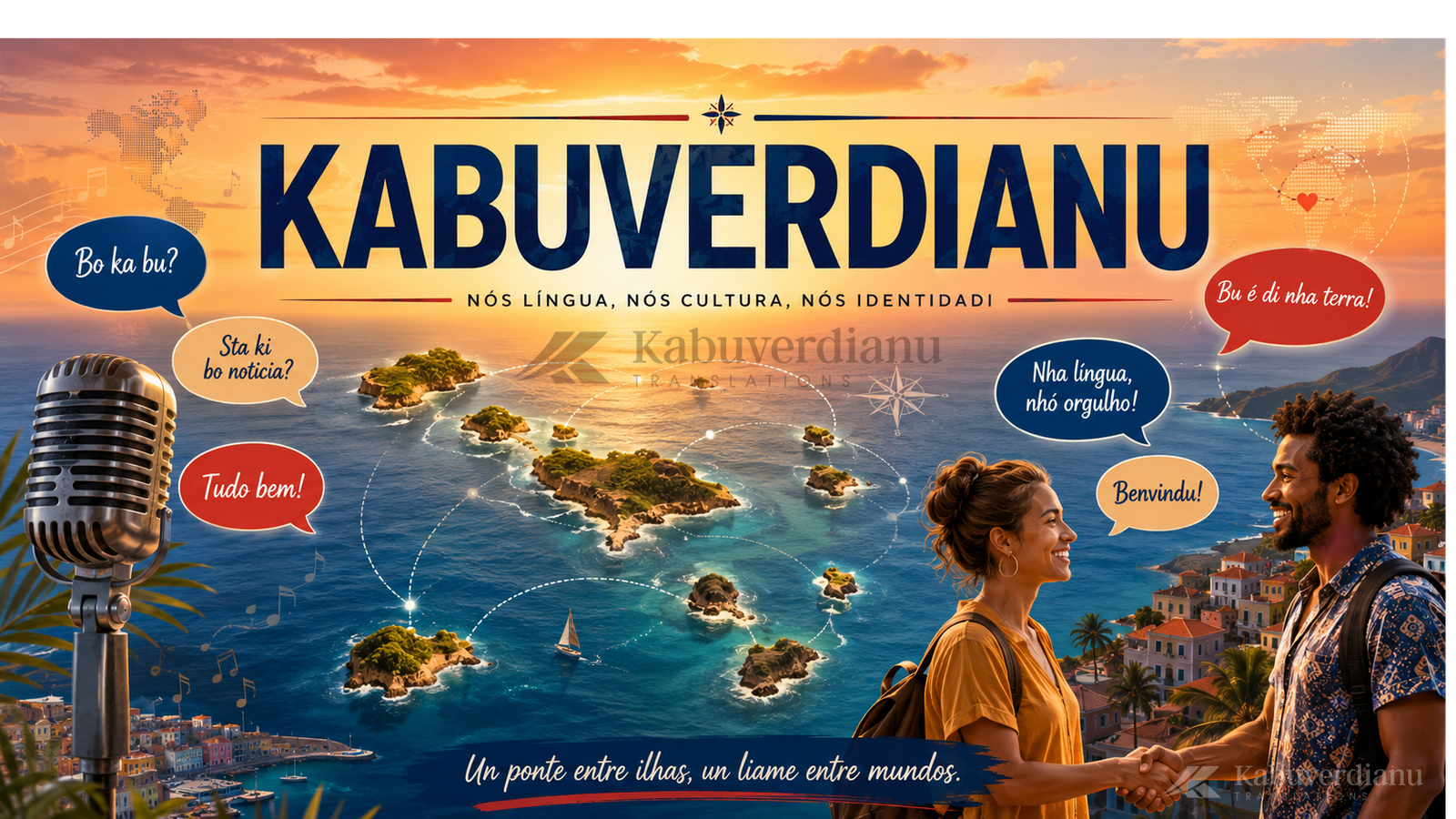
What is Kabuverdianu? — Cape Verdean Creole Explained
If you have ever heard someone from Cabo Verde speak and thought — “that sounds like Portuguese, but it isn’t” — you have heard Kabuverdianu.
Here is what you need to know about it.
What Does “Kabuverdianu” Mean?
Kabuverdianu simply means Cape Verdean in the language itself. It is the name Cape Verdean people use for their own language — though you will also see it called:
- Kriolu — the most common informal name used by locals
- Cape Verdean Creole — the standard English term
- Cabo Verdean Creole — the Portuguese-influenced spelling
- Crioulo — the Portuguese term
All of these refer to the same language. On this blog, I use Kabuverdianu and Kriolu interchangeably — because that is how we speak it at home.
Where is Kabuverdianu Spoken?
Kabuverdianu is the native language of Cabo Verde — an archipelago of ten islands located in the Atlantic Ocean, roughly 570 kilometres off the northwest coast of Africa.
It is spoken by approximately 1 million people worldwide, including a significant diaspora in:
- 🇺🇸 United States — particularly Massachusetts (New Bedford, Brockton, Boston) and Rhode Island
- 🇵🇹 Portugal — Lisbon, Porto, and surrounding areas
- 🇳🇱 Netherlands — Rotterdam and The Hague
- 🇫🇷 France and other parts of Europe
Despite Portuguese being the official language of Cabo Verde, Kabuverdianu is the language of daily life. It is the language of family, music, humour, love, and identity. When two Cape Verdeans meet anywhere in the world — New York, Lisbon, or Rotterdam — they will almost always greet each other in Kriolu, not Portuguese.
Is Kabuverdianu a Language or a Dialect?
A language. A fully formed, independent language — not a dialect of Portuguese.
Yes, much of its vocabulary comes from Portuguese. But Kabuverdianu has its own grammar, its own phonology, its own sentence structures, and its own written standard. A native Portuguese speaker cannot understand a conversation in Kabuverdianu without specific study of the language.
I have written a full post on this topic here: Is Cape Verdean Creole a Language or a Dialect? The Debate Explained
Does Kabuverdianu Have Dialects?
Yes — and this is important. The ten islands of Cape Verde are divided into two groups, each with its own variety of the language:
- Sotavento (southern islands, including Santiago and Fogo) — the most widely spoken variety, with a stronger African linguistic influence. This is the variety spoken in Praia, the capital.
- Barlavento (northern islands, including São Vicente and Santo Antão) — with stronger Portuguese influence and distinct vocabulary.
These two groups are mutually intelligible but noticeably different — similar to how British and Australian English feel different to a trained ear. A professional Cape Verdean Creole interpreter must be able to navigate both.
For a deep dive: Sotavento vs Barlavento — The Two Dialects of Cape Verdean Creole Explained
Can Google Translate Handle Kabuverdianu?
No — not reliably. Google Translate has extremely limited support for Kabuverdianu, and where it exists, the results are often inaccurate, culturally off, or simply wrong.
This matters enormously in professional settings. A mistranslated hospital consent form, a legal document with the wrong meaning, or an interpreter who speaks Portuguese instead of Kriolu can have serious consequences for real people.
I cover this in full here: Why You Cannot Use Google Translate for Cape Verdean Creole
Who Needs Kabuverdianu Language Services?
More people than you might think. In my nine years of professional work, I have provided Cape Verdean Creole interpretation and translation services for:
- Hospitals and health systems serving Cape Verdean patients
- Massachusetts state departments (DTA, DCF, DUA, EOHHS)
- Law firms and immigration attorneys
- Academic research institutions
- Schools and school districts
- Language service companies (LSPs)
If you work with Cape Verdean communities — or you are building a language service network that includes this language pair — I have written a full guide here: Who Needs a Cape Verdean Creole Interpreter? A Complete Guide
A Living, Evolving Language
One final thing worth saying: Kabuverdianu is not a relic or a curiosity. It is a living language — spoken in hip-hop, social media, cinema, and literature. It is the language of morna (Cape Verde’s soul music, now a UNESCO Intangible Cultural Heritage) and funaná (its fast, electric rhythm). It is warm, expressive, rhythmic, and deeply human.
It deserves to be treated with the same professional rigour as any major world language — and that is exactly what I am here to provide.
Want to Learn It?
I run a series right here on this blog: 👉 Learn Cape Verdean Creole — Part 1: 20 Basic Words and Phrases
More parts are coming every week.
Need a Professional Cape Verdean Creole Translator or Interpreter?
I offer professional services in translation, interpretation (OPI & VRI), transcription, subtitling, LQA, and more — in Cape Verdean Creole, Portuguese, and English.
📧 contact@kabuverdianutranslation.com 🌐 kabuverdianutranslation.com